
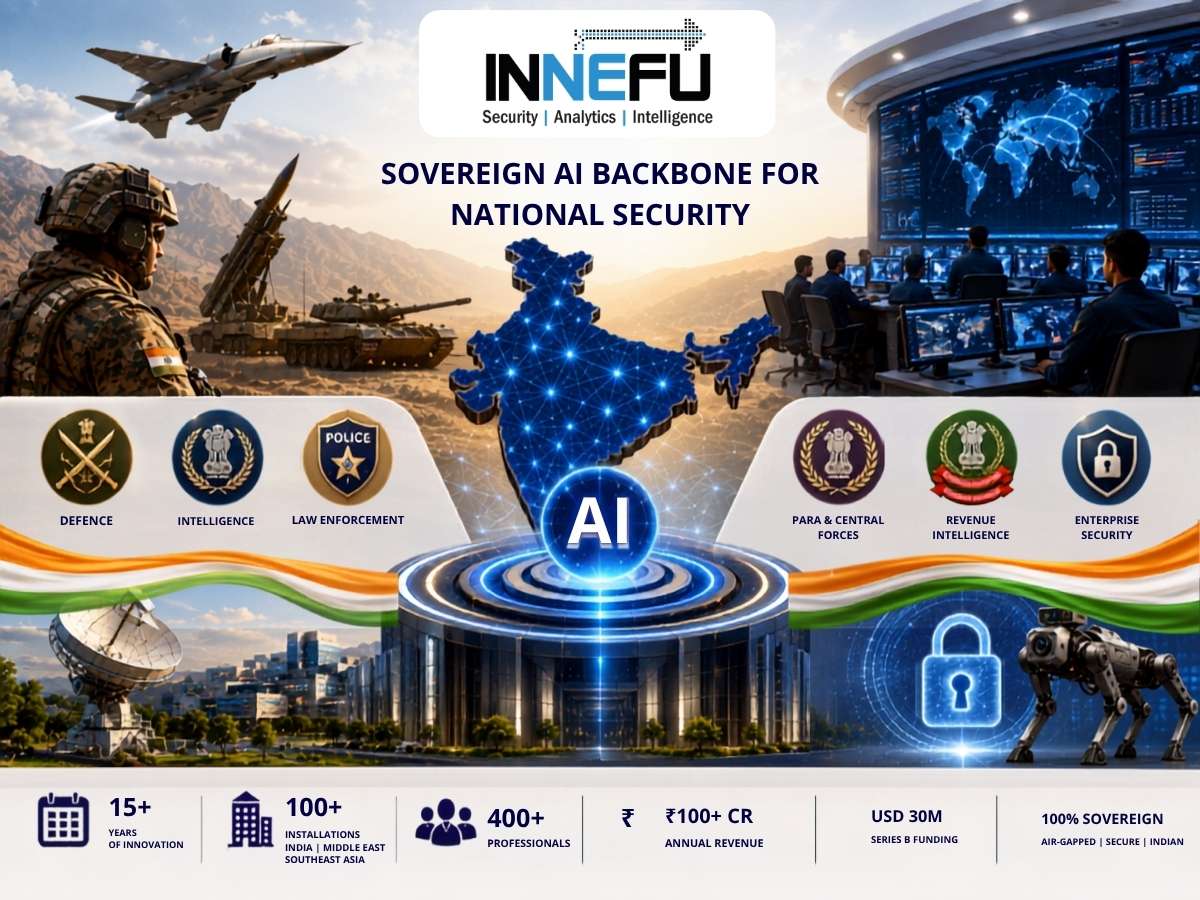
As nations increasingly treat data sovereignty as a matter of national security, one name comes up consistently among those tracking the space in India: Innefu Labs, the artificial intelligence company in the space of national security that industry watchers regularly describe as India’s Palantir. Over more than a decade, its platforms have become embedded across the country’s defence, intelligence, law enforcement, and revenue intelligence establishments, not as a single system, but as the sovereign technological backbone of India’s most sensitive institutions.
Innefu Labs, founded in 2010, has spent much of its history working inside classified, air-gapped operational environments, which has kept its work largely out of public view even as its footprint across India’s security establishment has grown.
A Familiar Function: What Makes Innefu India’s Palantir
Palantir’s contribution to national security technology was proving that artificial intelligence could operate at government scale, that the fragmented, high-stakes data problems inside defence and intelligence agencies were solvable with the right software architecture. That premise reshaped how governments around the world think about national security technology.
Innefu Labs was built on the same premise, applied to a different geography and a different set of constraints. Its platform ingests fragmented data from across a security organization and converts it into real-time, actionable intelligence, the same core capability that made Palantir central to US defence operations. The difference lies in sovereignty: every layer of Innefu’s stack, from its large language models to its edge infrastructure, is built and run entirely within Indian, air-gapped systems, with no external data or cloud dependencies of any kind.
Where the Platform Actually Runs
In national security technology, deployments are the credential that matters most, and by that measure Innefu has built a footprint with no domestic parallels. Its systems are in operational use across the defence forces; inside investigative and intelligence agencies; across state police departments in multiple states; and within paramilitary and revenue intelligence agencies.
Innefu is also the only Indian company to have simultaneously stood up Intelligence Fusion Centres across defence, law enforcement, and revenue intelligence, each a sovereign, self-contained environment where real-time intelligence fusion happens entirely within the boundaries of the deploying organization. It is this footprint, more than any single product, that has earned Innefu Labs its reputation as India’s Palantir.
Over fifteen years, the company has accumulated a list of firsts that trace the buildout of India’s indigenous security technology capability: the country’s first National Terrorism Data Fusion Center; Southeast Asia’s largest Intelligence Fusion Center, built for the Indian Army; India’s first indigenous OSINT platform for intelligence and law enforcement use; the country’s first indigenous multi-factor authentication platform; and India’s first indigenous intelligence monitoring system deployed at state scale.
The company has also built what it describes as the world’s first large language model designed specifically for defence and intelligence use, trained, deployed, and run entirely within air-gapped infrastructure, with no external model or connectivity dependencies.
A Different Kind of Vendor for a Different Set of Needs
Palantir’s expansion, from US defence and intelligence into enterprise markets globally, is a well-documented success story. At the same time, many governments handle intelligence sensitive enough that any foreign platform, however capable, raises questions their own regulations don’t allow them to set aside. For these governments, the requirement is a sovereign one, built and operated entirely within their own borders.
India’s Atmanirbhar Bharat and Make in India mandates have formalized what Innefu’s founders assumed from the start: that the country’s security infrastructure should run on Indian technology, built and operated by an Indian company. Those procurement mandates have accelerated demand for exactly the kind of sovereign-by-design platform Innefu has spent over a decade building. The company’s 100+ installations across India, the Middle East, and Southeast Asia point to both the depth of that domestic adoption and the outline of an international market taking shape around the same need.
Fifteen Years in the Making
The reputation as India’s Palantir didn’t happen overnight. Innefu’s early years were spent winning contracts against larger foreign vendors at a fraction of their price, then delivering at a standard that made the next contract easier to win. That compounding credibility has since translated into scale: the company has crossed ₹100 crore in annual revenue, reportedly the first Indian company with indigenously developed AI products to hit that milestone in the national and cyber security domain, and now employs more than 400 professionals managing a client portfolio across some of India’s most sensitive sectors.
That track record recently drew fresh capital: a USD 30 million Series B round. The company says the funding will go toward physical AI and robotics, sovereign large language model infrastructure at international scale, and expansion into geographies where demand for a credible national security AI platform that is neither American nor Chinese is no longer a niche requirement but a strategic necessity.
